
“The wars in Syria and Ukraine show a great need to develop new technologies for early CBRN* detection, monitoring, diagnosing, protection and effective communication to limit the harmful effects of such life-threatening exposure – potentially protecting and saving military and civilian lives.”
How we work
Watchbird conducts research and development in close collaboration with university sector, defence research institutions, government stakeholders, and operational end-user communities. Our development process is driven by real-world operational requirements and informed by field feedback from military and security personnel. By working alongside research partners and relevant authorities, we ensure that our solutions are grounded in scientific testing, validated methodologies, and practical deployment conditions. This integrated R&D approach allows us to refine performance, durability, and usability — delivering solutions that meet the evolving demands of modern operational environments.
Watchbird® SAFE Sensor Concept
SAFE Sensor – Detection
Watchbird® SAFE is a Human Performance Program (HPP) to support, identify, monitor, warn, protect and communicate individual health risk exposure from different activities like breaching with high explosives or firing of heavy handheld weapons.
The SAFE Concept utilizes Sensor technology to increase the awareness of health risks, by introducing fact-based thresholds for risk exposure, combined with real-time risk monitoring to provide early warning to the individual soldier on his health risk status. This information is crucial to prevent injuries and need for medical treatment.
This answers one of the most difficult tasks in HPP; How to mitigate operational risks versus impact to the individual operator´s health status.
Watchbird® CBRN Sensor Concept
CBRN Sensor – Detection
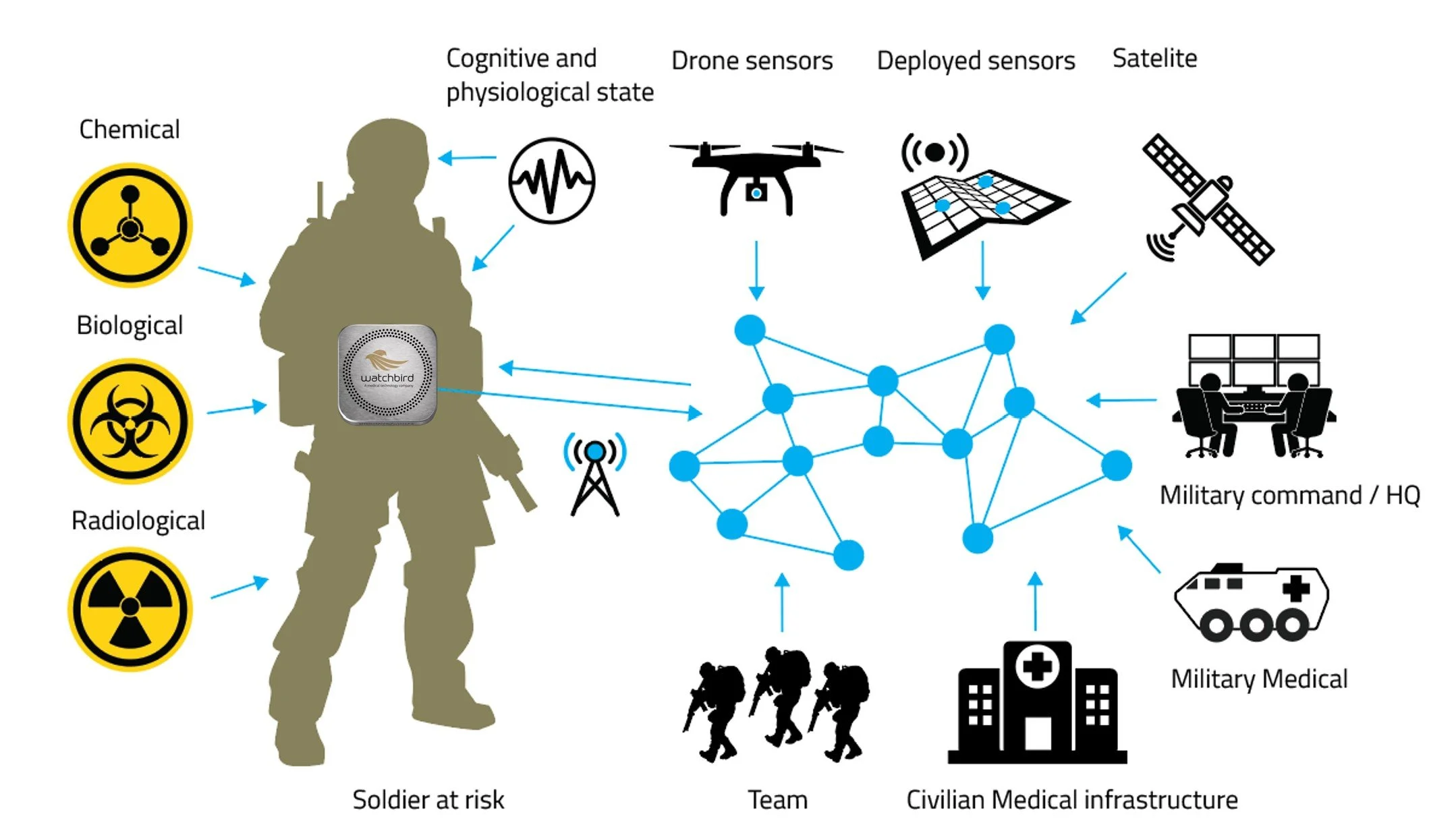
The Watchbird® CBRN mini multi-sensor will be a flexible capability which may be utilized in different ways where armed forces can be exposed to CBRN threats or other air pollution agens. The small sensor can be attached to individual soldiers, to vehicles, equipment, drones, and be deployed in the terrain etc. The CBRN mini multi-sensor will include robust and secure long-range communication technology, and will have a fully automatic detection and warning algorithm. It will be low weight, properly capsulated and designed according to military requirements. The battery will have a long life and standby capacity.
The network topology is typically MESH technology where soldiers are automatically notified by the sensor to sensor messaging where sensors receive and relay alarms in a chain reaction.
All Watchbird® sensors will be developed through extensive use of commercial technology tailored for meeting military – and civilian – requirements. Open architecture is key to interconnect and to be compliant with the various communication systems and battery technologies already implemented by national and allied military forces - as well as the different standards used in the civilian markets.
Watchbird® mini multi-sensor concept

Technological approach

The illustration image is AI-generated and is an example on how the CBRN-sensor can in shape and size.
For early warning, identification, diagnosis, protection and rapid communication of CBRN threats. The sensor alerts of an immediate threat and facillitates the individual soldier and troops units to implement early protective measures against CBRN exposure on the battlefield.
DETECT TO PROTECT AND STAY OPERATIONAL™
Watchbird® will develop, produce and deploy mini multi-sensors and equipment carried by personnel giving early warning, identification, diagnose, protection and rapid communication of CBRN exposure to the team and the command center, to protect and improve military performance and ensure operational capability.
To our knowledge, no other companies occupies this space addressed by Watchbird®
The close collaboration between the Norwegian Armed Forces, FFI (Norwegian Defence Research Establishment) and Watchbird® will provide an unique understanding and insight into operational needs, applied R&D and preferred solutions implemented in today’s and future defence operations.